
Succeeding in Generative AI Adoption in Business: 2025 Strategic Guide

Your next creation starts with a sentence. — free credits on sign-up Bring my idea to life
Succeeding in Generative AI Adoption in Business: 2025 Strategic Guide
Generative artificial intelligence has revolutionized the technology landscape in recent years, offering unprecedented opportunities to transform business processes. Yet, despite initial enthusiasm and massive investments, many organizations struggle to effectively integrate these technologies into their daily operations. In 2025, the challenge is no longer accessing these technologies, but adopting them strategically to derive real value. This guide offers a pragmatic approach to successfully adopting generative AI within your organization.
Why generative AI adoption often fails
The obstacles to successful generative AI adoption are not limited to restrictive corporate policies or the lack of relevant use cases. In reality, failures often stem from an overly technology-centric approach that neglects human and organizational aspects.
As explained in the patterns for developing GenAI products, failure often comes from a poor understanding of real user needs and insufficient integration into existing workflows. Companies that focus solely on technology without rethinking their processes generally experience disappointing results.
Key success factors for generative AI adoption
1. Cultivate a culture of experimentation
Successful generative AI adoption starts with creating an environment conducive to experimentation. Rather than immediately seeking large-scale projects, encourage teams to test small-scale applications to identify those that deliver tangible value.
Successful companies establish "innovation labs" where employees can experiment with AI tools like ChatGPT in a secure environment, without fear of failure. This approach helps uncover unanticipated but highly relevant use cases.
2. Train and support employees
Training is a key pillar of successful adoption. Beyond simply mastering the tools technically, employees need to understand how generative AI can transform their daily work and boost their productivity.
Effective training programs include:
- Awareness sessions on the fundamentals of generative AI
- Hands-on workshops on using specific tools
- Training on the art of prompt engineering
- Feedback from early adopters
- Guides on integrating AI into existing workflows
Ongoing support, particularly through AI-assisted coaching solutions, helps overcome initial hurdles and encourages long-term adoption.
3. Integrate AI into existing workflows
One of the most common mistakes is treating generative AI as a standalone tool. For successful adoption, these technologies must integrate seamlessly into existing workflows, complementing tools already in use rather than abruptly replacing them.
| Ineffective approach | Effective approach |
|---|---|
| Imposing AI as the primary tool | Integrating AI as an assistant within existing tools |
| Completely replacing processes | Gradually improving processes with AI |
| Global deployment without customization | Adapting to each team's specific needs |
| Focus on cost savings | Focus on increasing value produced |
Companies that succeed in adoption often start by integrating text generators into their existing communication or marketing tools, creating a smooth transition.
Practical strategies for successful adoption
1. Identify internal champions
Internal champions are enthusiastic employees who quickly adopt new technologies and encourage their colleagues to do the same. Identify these individuals across different teams and empower them to share their expertise and enthusiasm.
These ambassadors can play a crucial role in demonstrating the value of generative AI through concrete, relevant use cases for their respective teams. Their example-driven approach is often more effective than top-down directives.
2. Create AI centers of excellence
An AI center of excellence brings together experts who can guide the organization through its adoption journey. This center can:
- Develop best practices tailored to the company's context
- Evaluate and select the most relevant tools
- Create customized training resources
- Support teams in their initial projects
- Measure and communicate on results achieved
Initiatives like the Hub France IA show the importance of creating ecosystems of excellence to accelerate the adoption of these technologies.
3. Adopt a progressive approach
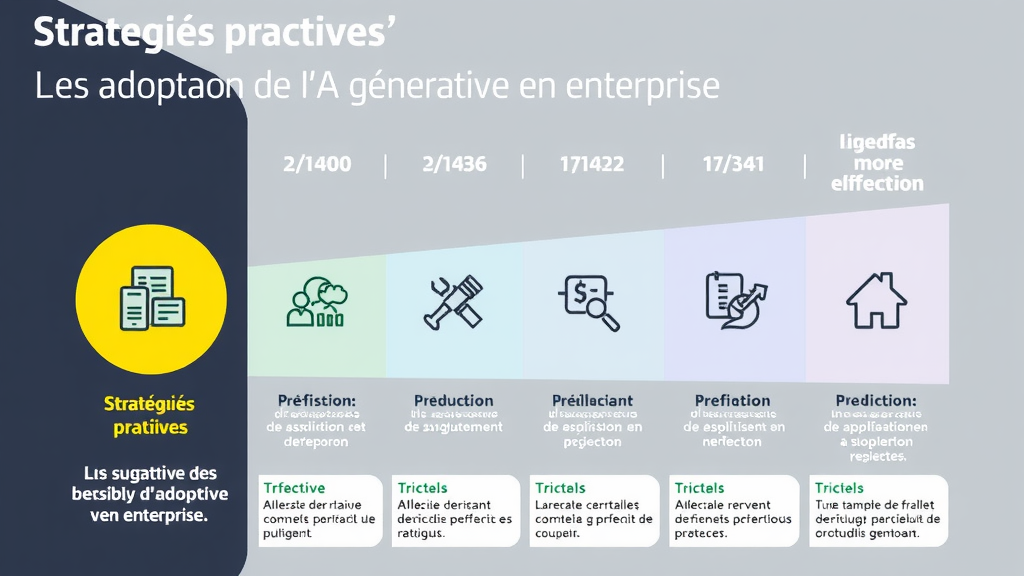
Successful generative AI adoption typically follows a progressive path:
- Exploration phase: Experiment with generic tools like Le Chat or other ChatGPT alternatives
- Targeted adoption phase: Deploy specific solutions to solve identified problems
- Integration phase: Incorporate AI into existing systems and processes
- Transformation phase: Redesign processes to fully leverage AI capabilities
This step-by-step approach helps limit risks while maximizing long-term success.
Measuring adoption success
To ensure your adoption strategy bears fruit, it's essential to define and track relevant metrics:
1. Usage metrics
- Adoption rate by team or department
- Frequency of AI tool usage
- Diversity of use cases
2. Performance metrics
- Time saved on AI-assisted tasks
- Improved quality of deliverables
- Reduction in errors or required iterations
3. Satisfaction metrics
- User satisfaction
- Perception of added value
- Willingness to expand usage to other areas
Analyzing these metrics allows you to adjust your strategy and identify areas needing additional support. As shown in the study on AI errors, it's crucial to closely monitor performance to avoid unforeseen consequences.
Challenges to anticipate
Despite a structured approach, several challenges can hinder generative AI adoption:
1. Resistance to change
Fear of being replaced by AI or reluctance to change established work habits can slow adoption. To overcome this resistance:
- Clearly communicate AI's role as an augmentation tool, not a replacement
- Involve teams in defining use cases
- Highlight human skills that AI cannot replace
2. Ethical and privacy concerns
Concerns about data privacy or potential biases in AI systems are legitimate. To address them:
- Establish clear policies on data usage
- Choose secure infrastructure solutions like AWS AI or European alternatives
- Train users on ethical issues
- Implement monitoring and auditing mechanisms
3. Unrealistic expectations
Exaggerated promises about generative AI capabilities can lead to disappointment. To manage expectations:
- Communicate honestly about current capabilities and limitations
- Set realistic, measurable goals
- Celebrate small wins rather than aiming for immediate radical transformations
It's important to remember that even the most advanced solutions like Google DeepMind have their limits and do not yet represent general artificial intelligence.
Conclusion: putting people at the heart of adoption
The success of generative AI adoption in business depends not primarily on policies or use cases, but on the ability to put people at the center of the approach. Organizations that view AI as a tool to augment human capabilities, rather than simply a means of automation, are the ones that reap the greatest benefits.
By following a progressive, user-centered approach supported by a culture of continuous learning, your organization can turn generative AI from a promising technology into a true driver of performance and innovation.
Want to accelerate generative AI adoption in your organization? Sign up for free at Roboto to discover how our platform can support you in this transformation.