Claude Haiku 5.5, Sonnet 5.5, Gemini 4 Argon, Mistral Large 4: Which Model to Pick for Writing, Coding and Analysis
Three labs, four models, one week. According to CNET, Google, Anthropic and Mistral AI rolled out new model versions back to back: Claude Haiku 5.5 and Claude Sonnet 5.5, Gemini 4 Argon and Mistral Large 4. These releases are not equivalent. Some are incremental speed-and-price updates; others promise deeper gains. Here is what actually changes if you write, code or analyze documents for a living, and how to choose without trusting vendor numbers alone.
What was announced, briefly
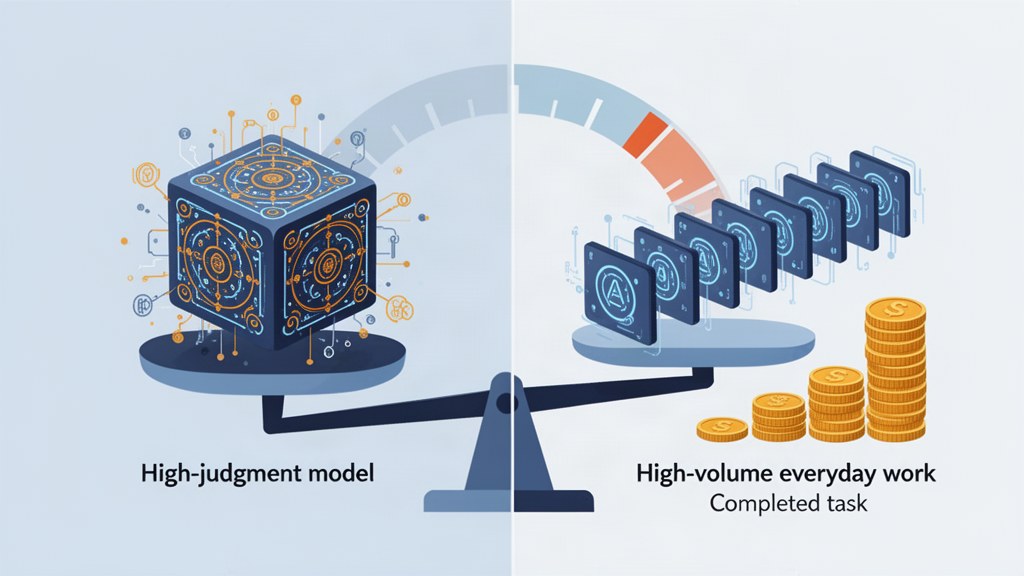
Claude Haiku 5.5 is described as the first major refresh in a year of Anthropic's cheapest and fastest model. The company says it costs roughly 75% less to run than the previous Haiku and targets high-volume, cost-sensitive tasks. A new feature for this line: an adjustable effort setting, a first for Haiku according to Anthropic. The company also reports progress in computer use, knowledge work, agentic coding and visual reasoning.
Claude Sonnet 5.5 is framed as a clear improvement over version 5.0. Anthropic highlights alignment and cybersecurity at a level it compares to Opus 5, plus gains in agentic coding and knowledge work, with coding the most emphasized. The company also mentions stronger protection against distillation attacks.
Gemini 4 Argon, Google's frontier model, remains limited to a small number of users through the Fairwind program. It offers a one-million-token output limit and reinforced deep reasoning. Mistral Large 4, nicknamed "Le Chonk," is in public preview, with an official rollout announced for October 27. Mistral AI ranks it among the best open-weight models, with claimed specialization in cybersecurity, geospatial work and agentic AI.
Writing: where the difference shows
For large-scale text production, the question is not just raw quality but cost per call. A model like Haiku 5.5, with its announced price cut and effort setting, is designed for repetitive flows: summaries, rewrites, short answers, classification. The effort setting theoretically lets you trade speed for depth depending on the task, which matters when you process thousands of documents.
For more demanding text — argumentation, tone adaptation, long-form content — Sonnet 5.5 or Mistral Large 4 look more relevant on paper. One caveat: the source provides no detail on multilingual capabilities or French-language output for any of these models. That is a significant gap for anyone writing in French, since vendor announcements tend to focus on English. Caution is warranted before switching an entire editorial pipeline.
Coding: what the vendors claim
Coding is where the announcements get most specific. Anthropic says Sonnet 5.5 improves most in agentic coding, meaning tool use and multi-step task execution. Haiku 5.5 is also credited with agentic coding gains, but with a volume-and-cost focus. Mistral Large 4 claims specialization in agentic AI, echoing the same trend: models are increasingly judged on their ability to act, not just respond.
For a developer, the choice will depend less on the "best" model than on the task type: short, high-volume code generation (Haiku 5.5), refactoring and complex agentic work (Sonnet 5.5), or specialized scenarios (Mistral Large 4). These remain vendor claims, not independent measurements.
Analysis: reasoning, context and access
For long-document analysis, Gemini 4 Argon stands out with its one-million-token output limit and reinforced deep reasoning. It is the most ambitious of the four on that front, but also the least accessible: it stays limited to a few users via Fairwind, with no public timeline announced. You cannot build a workflow on it today.
Sonnet 5.5, with its claimed knowledge-work gains, and Mistral Large 4, with its geospatial specialization, target more focused analytical uses. Again, the source offers no figures to settle the question.
Quick comparison
- Claude Haiku 5.5 — volume, lower cost (about 75% less per Anthropic), adjustable effort setting. Best for repetitive flows.
- Claude Sonnet 5.5 — agentic coding and knowledge work, stronger alignment and cybersecurity per the vendor.
- Gemini 4 Argon — deep reasoning, output up to one million tokens, restricted access (Fairwind).
- Mistral Large 4 — public preview, rollout announced for October 27, specialization in cybersecurity, geospatial and agentic AI.
Key takeaways
First, do not confuse announcement with availability: only Mistral Large 4 is in public preview, Gemini 4 Argon remains closed, and the Anthropic models are presented as available but with no detail on free tiers in the source.
Second, the performance figures come from the vendors, not independent testing. The source does not state that its authors tested these models themselves. Treat the numbers as orders of magnitude to verify against your own use cases.
Third, for French-language work the uncertainty is real: no information on multilingual capabilities is provided. If French writing is central to your workflow, plan an evaluation phase on your own texts before deploying anything.
Finally, the right reflex is not to hunt for a single model but to match the tool to the task: a small fast model for volume, a mid-tier model for code and analysis, a frontier model when access allows. That is also the promise of a platform like Roboto, which generates texts, images, videos and voiceovers with AI: this article is published by Roboto.
Source
Anthropic, Google and Mistral Unveil Their Latest AI Models: What’s New and Why It Matters