Using ChatGPT to recover 9 TB after a failure: what this case really shows
What do you do when a storage enclosure suddenly vanishes from your network, with years of data inside? An author at MacGeneration describes living through exactly that, and reports recovering roughly 9 TB of data with ChatGPT's help, after saying that neither a specialist company nor forums had been useful. The account is worth reading for what it is: a personal testimony, not a validated recovery procedure. It is still instructive, both about the role a conversational assistant can play and about the false sense of safety RAID1 creates.
The setup: a DAS in RAID1, not a NAS
The installation described is not a NAS but a TerraMaster DAS connected over Thunderbolt. The enclosure has two 3.5-inch bays with hardware RAID1, and it is attached to a Mac mini M1 that is itself connected to the local network at 10 Gb/s. Two 10 TB drives were configured in RAID1.
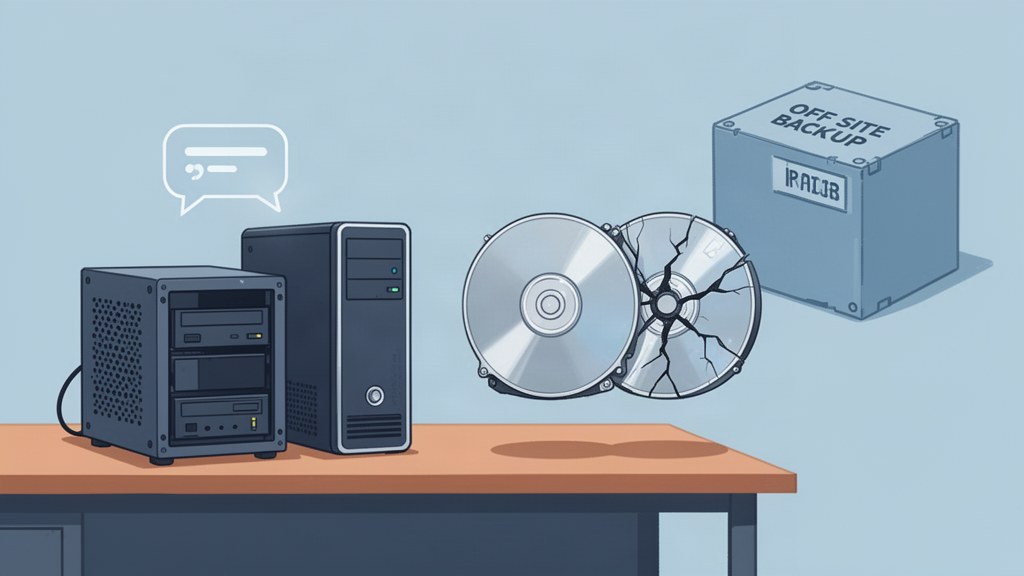
RAID1 mirrors data onto a second volume and offers good read throughput. It is fault tolerance: if one drive fails, the other keeps responding. It is not a backup. RAID1 protects against neither human error nor file system corruption. That is precisely the trap the author says he fell into: the DAS data was neither replicated elsewhere nor backed up, and he cites cost as the reason for skipping backups.
What the account says — and what it does not
The reported facts are limited. The enclosure was no longer visible on the network, the problem occurred after a power outage, and the author says he recovered around 9 TB with ChatGPT's help. However, the headline mentions a power outage that the body of the text does not detail. The step-by-step method, the exact prompts used and the concrete limits of ChatGPT's help are not described in the available excerpt. Any reconstruction of those steps would be speculation.
So this story should not be turned into a tutorial. We do not know whether ChatGPT identified a technical lead, helped interpret error messages, suggested an order of operations, or simply acted as a thinking partner. Those uses are plausible, but they are not documented here.
Why a conversational assistant can help with this kind of failure
Even without the details of the exchanges, the case illustrates an AI use that goes beyond text generation. Faced with a storage failure, an assistant can help to:
- rephrase a vague technical problem into precise questions to ask a vendor or a forum;
- explain the vocabulary involved (RAID, file system, mounting, Thunderbolt) so you can better understand your options;
- draft a checklist of checks to run before any risky manipulation;
- help interpret logs or error messages, provided you supply them and stay critical.
These are general uses of a conversational assistant, not a description of what happened in this specific case. No testing was performed to validate them.
Limits to know before relying on an AI
A conversational assistant cannot read your drives, cannot see the SMART status of your volumes, and cannot verify its own hypotheses. It can be confidently wrong, suggest a destructive operation, or miss a hardware detail specific to your enclosure. On data that exists in only one place, a bad suggestion can turn a reversible failure into permanent loss.
Basic caution means not writing anything to the affected drives, not launching a format or RAID rebuild without understanding the consequences, and handing the hardware to a professional when the value of the data justifies it. The author saying that neither a specialist company nor forums helped him is part of his account; it does not mean a professional would be useless in another case.
The real lesson: RAID1 is not a backup
The strongest point in this testimony is not about AI but about storage architecture. Hardware RAID1 on a DAS, however fast its reads, does not replace a backup. A backup means a copy somewhere else, ideally following the 3-2-1 rule: three copies, on two different media, one of them off-site.
Cost is often cited to postpone that expense. That is understandable, but it should be weighed against the cost of a loss, the time spent attempting recovery and the uncertainty of the outcome. In this particular case, the author says he came out of it with around 9 TB recovered; not everyone will be that lucky.
Key takeaways
- The account reports recovering around 9 TB with ChatGPT's help, but the method and prompts are not documented in the available excerpt.
- The setup described is a TerraMaster DAS over Thunderbolt with hardware RAID1, attached to a Mac mini M1 — not a NAS.
- RAID1 tolerates a single drive failure but does not protect against human error or file system corruption.
- A conversational assistant can help frame a problem and understand options, but it replaces neither hardware diagnostics nor a professional.
- Backups remain the only real protection, whatever the RAID level.
This case is a useful reminder: AI can be a good intellectual copilot during a failure, as long as you do not delegate irreversible decisions to it.